
Can a Pomeranian Be a Service Dog? The Surprising Truth About Tiny Heroes

Lateef Bhatti
Author
Yes, can a Pomeranian be a service dog? The answer is a big yes! Even though they are small, Pomeranians can be trained as service dogs to help with medical alerts, hearing signals, or calming someone with anxiety. While they are too tiny to pull a wheelchair, their smart brains and great sense of smell make them perfect “pocket-sized” heroes for people who need a helping hand.
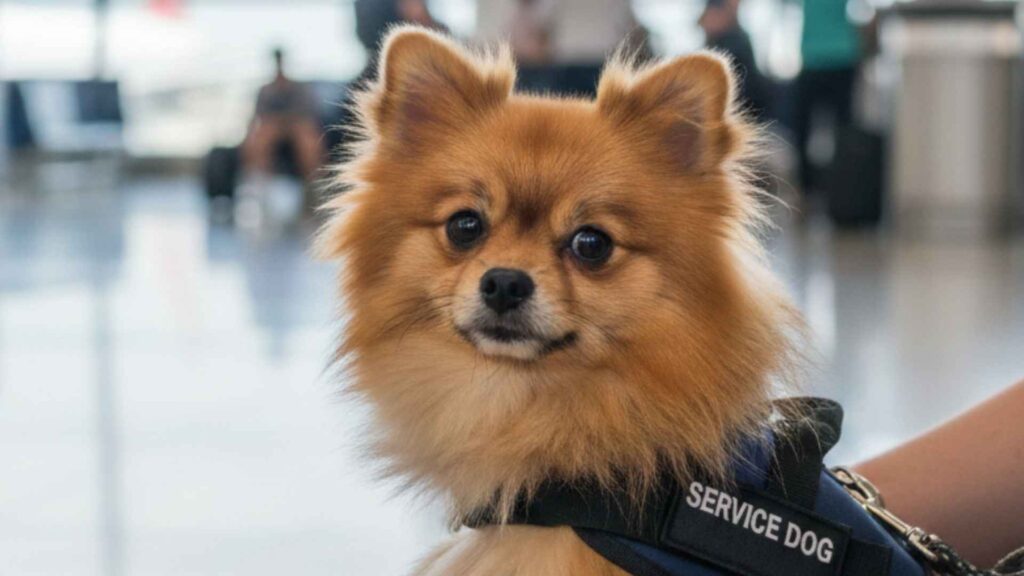
When you think of a service animal, your mind likely leaps to a sturdy Labrador or a focused German Shepherd. You probably don’t picture a five-pound ball of fluff with a “personality plus” attitude navigating a busy airport. However, the short answer is a resounding yes—can a Pomeranian be a service dog? Absolutely.
Table of Contents
ToggleWhile they won’t be pulling wheelchairs or acting as physical braces for walking, their high intelligence and “velcro” attachment to their owners make them elite candidates for medical and psychiatric alert work. In this definitive 2026 guide, we explore how these “Big Dogs in Small Bodies” are rewriting the rulebook on canine assistance.
What Tasks Can a Pomeranian Service Dog Actually Perform?

Under the ADA, a Pomeranian service dog must be trained to perform life-saving tasks that directly mitigate a handler’s disability. Because they are so closely in tune with their handlers, they often pick up on “micro-signals” that humans—and even some larger breeds—might miss.
Pomeranians are surprisingly versatile. Their acute senses make them masters of “invisible” medical assistance. They aren’t just pets; they are biological monitors.
- Medical Alerting: They can be trained to sniff out chemical changes in breath or sweat to alert for hypoglycemia or migraines.
- Psychiatric Intervention: As a Pomeranian psychiatric service dog, they can perform “Deep Pressure Therapy” (DPT) by sitting on a specific part of the body to ground a handler during a flashback or panic attack.
- Hearing Alerts: They are excellent at alerting handlers to doorbells, smoke alarms, or a crying baby by nudging or performing a specific “alert” bark.
- Tactile Stimulation: For those with autism, a Pom’s unique coat texture and gentle licking can provide the sensory input needed to prevent a meltdown.
Is There a Difference Between a Service Dog and an Emotional Support Dog?
The primary difference between a service dog and an emotional support dog is “task training.” A service dog is legally required to perform a specific action, whereas an ESA provides comfort just by existing. This distinction is the most common point of confusion I see in the community.
If your Pom curls up with you when you’re sad, that’s an ESA. If your Pom is trained to recognize the onset of a panic attack and licks your hands to “break” the cycle of self-harm or dissociation, they are a Pomeranian service dog.
The Legal Landscape: ADA and ACAA
Under the Service dog laws ADA ACAA, service dogs have “public access rights.” This means your Pomeranian can accompany you into grocery stores, restaurants, and onto airplanes (in-cabin) for free. Are Pomeranians good support dogs? They are, but to have the legal protection of a service animal, you must be able to answer:
- Is the dog required because of a disability?
- What work or task has the dog been trained to perform?
Why Choose a Small Breed Service Dog Over a Large One?
Small breed service dogs offer unparalleled portability. They are often preferred for psychiatric or cardiac alerts because they can stay closer to the handler’s face and chest—where they can better detect changes in scent or heart rate. They are easier to transport in ride-shares, fit under airplane seats, and are generally less “intimidating” in public spaces.
Comparison: Large vs. Small Service Dogs

The "Information Gain": 3 Hidden Gems About Pomeranians You Didn't Know
Most generic articles tell you Poms are “smart.” As a breed expert, I want to go deeper into why they excel at service work:
- The “Sentinel” Instinct: Historically, Pomeranians were bred down from large Arctic sled dogs (the Spitz family). They retained the “watchdog” DNA. This means they don’t just “look” at you; they scan your environment. This makes them world-class for Pomeranian for anxiety and autism support, where the dog needs to “watch the handler’s back” in crowded places.
- Scent Sensitivity: Despite their tiny noses, Poms have a high density of olfactory receptors. Researchers have found that smaller dogs often have more concentrated focus during scent-detection tasks because they aren’t as easily distracted by heavy physical labor.
The “Velcro” Bond: Unlike some breeds that are happy to nap in another room, a Pom wants to be within three feet of you at all times. In service work, this “hyper-attachment” is actually a feature, not a bug—it ensures they never miss a medical alert.
What Is the Ideal Pomeranian Temperament for Service Work?
Not every Pomeranian is cut out for the vest. Pomeranian temperament and intelligence vary. To be a successful service dog, a Pom must be “bomb-proof.” This means they don’t yap at every passing leaf and don’t cower when a shopping cart rattles by.
When selecting a puppy for service work, we look for the “middle of the road” personality. You don’t want the bossy alpha who barks for dominance, nor do you want the shy pup hiding in the corner. You want the one who approaches a new toy with curiosity rather than fear.
Can You Manage Training a Pomeranian as a Service Dog at Home?
Training a Pomeranian as a service dog is highly effective due to their high “bidability,” but it requires a soft touch. They are sensitive to harsh corrections and respond best to high-value rewards like freeze-dried liver or tiny pieces of chicken.
The Service Dog Readiness Checklist
Before you start, ensure you have these essentials for your Pomeranian:
- Professional Harness: A “Y-front” harness to protect their delicate trachea.
- High-Value Treats: Low-calorie, as Poms gain weight easily.
- Socialization Log: Aim for 100 new sounds, textures, and people by 16 weeks.
- Grooming Kit: Service work requires a clean dog.
The Owner’s Perspective: Living With a "Big Dog in a Small Body"
Living with a Pom isn’t just about the fluff; it’s about the “intensity.” From my experience, Pomeranians don’t just “sleep” like Goldens; they patrol. They have a specific, sharp “alert bark” that sounds different from their “I want a treat” bark.
The biggest challenge? People. When you have a Pomeranian service dog, the general public often forgets they are working. You will constantly be stopped by people wanting to pet the “cute puppy.” As a handler, you must be prepared to advocate for your dog’s space. A “Do Not Pet” patch is mandatory, not optional.
Health, Genetics, and Safety: The "Service-Ready" Physical

Because your service dog is essentially medical “equipment,” their health is paramount. You cannot rely on a dog that is in chronic pain. Pomeranian characteristics and personality won’t matter if the dog’s body fails them.
Critical Screenings
- Luxating Patella: A major issue in the breed. Ensure your Pom has an OFA clearance for knees. A service dog that limps can be legally denied access to public spaces.
- Tracheal Collapse: Never use a collar for a working Pom. The pressure from a leash can damage their windpipe, ending their career.
- Advanced Cardiac Testing: Poms are prone to mitral valve disease. Yearly vet checkups are a must for any working animal.
Safety Disclaimer: Always consult with a veterinarian for a personalized health plan to ensure your Pomeranian is physically capable of the rigors of full-time service work.
The Technical Training Path: From Puppy to Pro
How do you get from a fluffy puppy to a focused Pomeranian psychiatric service dog? The path is usually broken into three phases:
Phase 1: Foundational Obedience (0–6 Months)
Focus on the “Big Three”: Sit, Stay, and Heel. For a Pom, “Heel” is particularly important because they are so low to the ground; they must learn to stay exactly by your ankle so they don’t get stepped on in crowds.
Phase 2: Public Access Training (6–12 Months)
Take your dog to “pet-friendly” stores first (like Home Depot or Petco). Reward them for ignoring other dogs and focused eye contact. Use the “Look at Me” command until it is reflexive.
Phase 3: Task Training (12+ Months)
This is where you teach the specific Pomeranian service dog tasks. If you need an anxiety alert, you will capture the moment you feel stressed, reward the dog for noticing, and pair it with a command like “Alert.”
Addressing the Challenges: Why Poms Sometimes Fail
It’s intellectually dishonest to say every Pom makes a great service dog. Here are the “deal-breakers”:
- Barking: Poms are naturally vocal. A service dog that barks out of excitement or fear in a restaurant is no longer a service dog under the law.
- Fragility: They can be stepped on in busy malls. A handler must be hyper-aware of the dog’s physical safety.
Potty Training: Small dogs have small bladders. Maintaining a “bulletproof” potty schedule is harder with a Pom than a larger breed.
Social Proof: What the Community Says
On forums like Reddit and breed-specific clubs, the consensus is clear: Pomeranians are the “secret weapon” of the psychiatric service world. Many handlers report that while they initially felt “judged” for having a tiny service dog, the effectiveness of the breed in detecting heart rate changes or interrupting “zoning out” (dissociation) is second to none.
The AKC ranks them high in intelligence, and while the UKC classifies them as companions, their work ethic in “Competitive Obedience” proves they have the “brain” for high-level service tasks.
Summary of the Pomeranian Advantage
If you live in an apartment, travel frequently, or deal primarily with psychiatric or non-weight-bearing medical issues, the Pomeranian is a stellar choice. They are portable life-savers that provide 24/7 monitoring without the “footprint” of a 70-pound dog.
People also ask:
Yes, Pomeranians make excellent psychiatric and medical alert service dogs. Their high intelligence and extreme devotion to their owners allow them to learn complex tasks, such as alerting to blood sugar changes or interrupting panic attacks. While they are too small for mobility tasks, they excel in almost every other category.
They are phenomenal for anxiety. Because of their “Velcro” nature, they are constantly checking in with their handler. They are frequently used as psychiatric service dogs to provide grounding, deep pressure therapy (by sitting on the handler’s lap), and “reality testing” for those with PTSD or social anxiety.
Generally, no. Pomeranians are highly social and prone to separation anxiety. This is especially true for service dogs, who are trained to be with their handlers 24/7. Leaving a Pom alone for long periods can lead to destructive behavior and “reversion” in their training.
While Labrador Retrievers and Golden Retrievers are the most common due to their size and “eager to please” nature, Pomeranians are becoming one of the most popular choices for psychiatric and medical alert roles where size is not a requirement.
The Border Collie and Poodle often take the top spots for raw intelligence, but the Pomeranian is widely considered the smartest of the “Toy” breeds. Their ability to learn a new command in fewer than 15 repetitions makes them highly capable of professional-grade service work.
In the United States, there is no “official” government registry for service dogs. Any website offering a “certification” for a fee is a scam. Under the ADA, legal status is granted by the dog’s training and the handler’s disability, not a piece of paper.
By nature, they are vocal. However, a trained service dog must be taught “public silence.” If a Pomeranian is properly trained, they will only bark to alert their handler of a medical emergency, which is permitted under the law.
You may also like
Build the Perfect Care Routine for Your Pomeranian

Select your Pom’s age, coat type, and activity level to instantly get a custom care checklist — it’s fast, free, and made with love!
Give your Pom the daily care they truly deserve.