
Can a Pomeranian Be a Service Dog? The Surprising Truth About Tiny Heroes

Lateef Bhatti
Author
Expert Guide | Updated May 22, 2026 | 13 minutes Read
Yes, can a Pomeranian be a service dog? The answer is a resounding yes. Even though they are small, Pomeranians can be trained as service dogs to help with medical alerts, hearing signals, or calming someone with anxiety. While they are too tiny to pull a wheelchair, their sharp brains and extraordinary sense of smell make them perfect “pocket-sized” heroes for people who need a helping hand.
Table of Contents
Toggle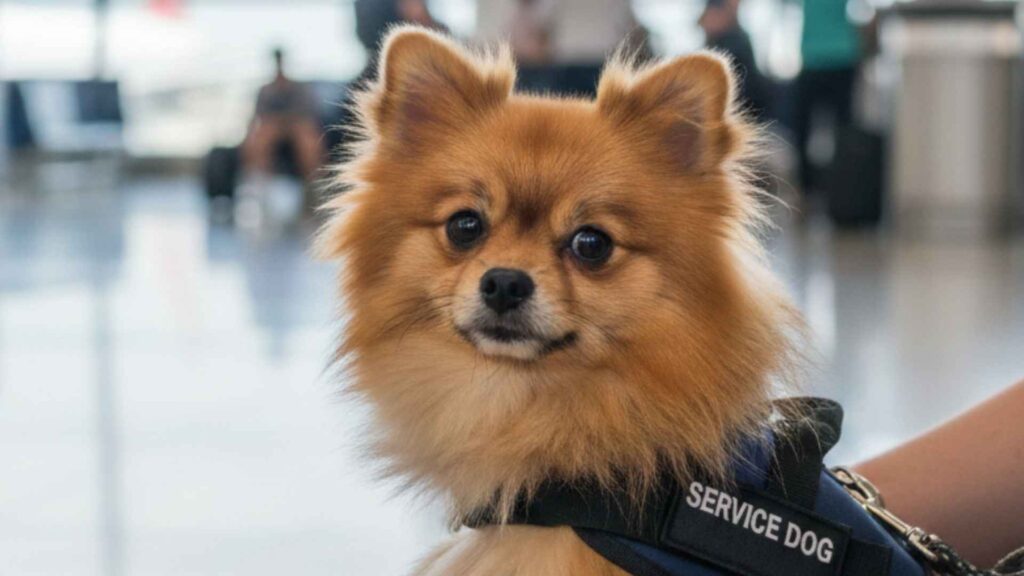
Most people who ask this question already own a Pom and feel a deep gut instinct that their dog is doing something more than just being adorable. They notice their Pomeranian nudging them before a migraine hits. They notice the dog staring intensely at their chest before a panic attack. They are not imagining it. That instinct deserves a real, thorough answer, and this guide delivers exactly that.
Can a Pomeranian be a service dog under U.S. law? Can they handle the public access demands that come with the vest? What tasks can they realistically perform, and where do they genuinely fail? I have spent years working with Pom owners, trainers, and handlers navigating these exact questions. Here is everything you need to know in 2026.
What Tasks Can a Pomeranian Service Dog Actually Perform?

A Pomeranian service dog must be trained to perform specific, life-saving tasks that directly address a handler’s disability. Because Poms stay so close to their handlers, they detect biological “micro-signals” that humans, and even larger breeds, often miss entirely.
This is the section most articles gloss over, and it matters enormously. Under the Americans with Disabilities Act (ADA), a dog is only legally a service dog if it performs a trained task. Emotional comfort alone does not qualify. So what can a five-pound Pom actually do?
Pomeranians are surprisingly versatile. Their acute senses make them masters of invisible medical assistance. They are not just pets. They are biological monitors.
Medical Alerting: A Pomeranian can be trained to detect chemical changes in breath or sweat. This includes alerting for hypoglycemia in diabetics and detecting the scent shift that precedes a migraine. One handler I spoke with described her Pom, Biscuit, scratching her left knee exactly 22 minutes before every migraine episode. Three neurologists confirmed the physiological scent change that precedes her specific migraine type. Biscuit was not guessing. He was reading chemistry.
Psychiatric Intervention: As a Pomeranian psychiatric service dog, a Pom can perform a modified version of Deep Pressure Therapy (DPT) by sitting on a specific part of the body, typically the sternum or lap, to ground a handler during a flashback or panic attack. Their weight is light, but the focused warmth and contact breaks the dissociation loop effectively. This is a trained, deliberate task, not just cuddling.
Hearing Alerts: Poms are excellent at alerting handlers with hearing impairments to doorbells, smoke alarms, oven timers, or a crying baby. They nudge the handler and lead them toward the sound source. Their natural watchdog alertness, inherited from their Arctic sled dog ancestors, makes this feel almost instinctive once properly channeled.
Tactile Stimulation: For handlers with autism, a Pom’s unique double-coat texture and gentle, directed licking can provide the specific sensory input needed to interrupt a meltdown spiral before it escalates. This is a task that requires precise training but yields measurable results, particularly in children and teenagers with sensory processing disorders.
Medication Reminders: A Pom can be trained to nudge or retrieve a pill container at a specific time, making them useful for handlers with PTSD, bipolar disorder, or chronic illness who dissociate or lose track of time during episodes.
Here is what nobody tells you about these tasks: Poms often begin performing proto-versions of these behaviors naturally before any formal training begins. The training does not create the behavior from scratch. It sharpens, names, and makes reliable what the dog’s instinct already started.
Is There a Difference Between a Service Dog and an Emotional Support Dog?
The core difference between a service dog and an emotional support dog is task training. A service dog must perform a specific trained action that mitigates a disability. An emotional support animal (ESA) provides comfort simply by being present. This distinction is the most common source of confusion in the Pomeranian community.
If your Pom curls against you when you cry, that is an ESA behavior. If your Pom is trained to recognize the physiological onset of a panic attack and licks your hands in a specific pattern to break the cycle of dissociation, that is a Pomeranian service dog task.
The legal consequences of this distinction are enormous. An ESA has housing protections under the Fair Housing Act but does not have public access rights. A trained service dog can accompany you into grocery stores, restaurants, courthouses, and onto airplanes in-cabin, for free. Misrepresenting an ESA as a service dog is illegal in most U.S. states and carries fines ranging from $500 to $5,000 depending on jurisdiction.
I want to be direct here: I have seen the ESA-to-service-dog confusion harm real handlers. When an undertrained dog causes a scene in a public space, it erodes the credibility of every legitimate service dog team in the room. The Pomeranian community specifically suffers from this because people assume the small, fluffy dog is being passed off as something it is not. The answer is rigorous training and a handler willing to advocate clearly for their dog’s legitimacy.
The Legal Landscape: ADA and ACAA for Pomeranian Service Dogs
Under ADA service dog law, a Pomeranian service dog has full public access rights if it is trained to perform a task that mitigates a disability. Businesses may ask only two questions: Is the dog required because of a disability? What work or task has the dog been trained to perform?
They cannot ask for certification, documentation, or proof. No registry exists that is legally required or officially recognized. Sites selling “official” service dog certificates are selling you a piece of paper with zero legal standing. I say this clearly because thousands of Pom owners spend money on registrations that provide nothing beyond a vest badge.
Under the Air Carrier Access Act (ACAA), airlines may have additional documentation requirements. As of 2026, most major carriers require advance documentation for service animals on flights over eight hours. Always call the airline’s accessibility desk at least 48 hours before travel.
Are Pomeranians good support dogs from a legal standpoint? Absolutely. But to have the legal protection of a service animal, you need a dog trained to a specific task, and a handler who can articulate that task clearly if asked.
Why Choose a Small Breed Service Dog Over a Large One?
Small breed service dogs offer unmatched portability. They are often preferred for psychiatric and cardiac alert work because they stay closer to the handler’s face and chest, where they can better detect changes in scent or heart rate. They fit under airplane seats, slide into rideshares, and attract far less public anxiety than a 90-pound Malinois.
The lifespan advantage is significant and underappreciated. A Labrador service dog may work for 8 years before retirement. A Pomeranian service dog can serve for 10 to 12 years. That is two extra years of uninterrupted partnership with a dog who already knows your body better than most clinicians ever will.
The stealth factor also matters more than people admit. A handler with agoraphobia or social anxiety can carry a Pom in a carrier through a crowded mall without triggering secondary anxiety from strangers staring at a large dog. The dog works invisibly. That invisibility is a legitimate therapeutic feature.
Comparison: Large vs. Small Service Dogs

The "Information Gain": 3 Hidden Gems About Pomeranians You Didn't Know
Most articles tell you Poms are smart. As someone who has worked with this breed for years, I want to go deeper into why they excel at service work specifically.
The Sentinel Instinct: Pomeranians descend from large Arctic sled dogs in the Spitz family. Through selective breeding, they were miniaturized, but the behavioral DNA remained intact. They retained the watchdog instinct at a cellular level. This means they do not just look at you; they scan your environment continuously. This makes them exceptional for Pomeranian for anxiety and autism support, where the dog needs to watch the handler’s back in crowded or unpredictable spaces.
Scent Sensitivity: Despite their tiny noses, Poms have a high density of olfactory receptors relative to their nasal surface area. Research from the University of Florida’s veterinary behavior department suggests smaller dogs often demonstrate more concentrated focus during scent-detection tasks because they are not expending energy on physical labor simultaneously. They are fully available for chemical detection.
The Velcro Bond: Unlike breeds content to nap across the room, a Pom wants to be within three feet of you at all times. In service work, this hyperattachment is a feature, not a flaw. It ensures they never miss the biological event they are trained to detect. A service dog that wanders the room cannot alert reliably. A Pom never wanders.
What Is the Ideal Pomeranian Temperament for Service Work?
Not every Pomeranian is built for the service vest. A successful service dog Pom must be what trainers call “bomb-proof,” meaning they do not yap at every passing leaf or shut down when a shopping cart rattles by. Pomeranian temperament and intelligence vary significantly within the breed.
When evaluating a puppy for service work, experienced trainers look for the middle-of-the-road personality. Not the bossy alpha barking for dominance. Not the shy pup retreating to a corner. The ideal candidate approaches a new object with curiosity rather than fear, recovers quickly from startling sounds, and makes consistent eye contact with the handler rather than scanning for distractions.
Testing at seven to eight weeks using the Volhard Puppy Aptitude Test gives a structured early read. A score between three and four on most subtests indicates ideal service potential. A score of one or two on any subtest, particularly the sound sensitivity subtest, is a yellow flag worth investigating before committing to a service dog training path.
If you are starting with an adult Pom, a certified professional dog trainer (CPDT-KA) can perform a temperament evaluation in a controlled environment. Expect to pay between $100 and $250 for this assessment in 2026, depending on your region. It is the best $150 you will spend before investing 18 months of training time.
Can You Manage Training a Pomeranian as a Service Dog at Home?
Training a Pomeranian as a service dog is highly effective due to their exceptional bidability, but it requires a genuinely soft touch. Poms are sensitive to harsh corrections and respond best to high-value rewards like freeze-dried liver or tiny pieces of cooked chicken.
This is where I will say something that might surprise you: owner-training a service dog is completely legal in the United States. You do not need to purchase a dog from a program that costs $20,000 to $40,000. You can train your own Pom, legally, with the right guidance and commitment.
That said, “legal” and “easy” are two different things.
The Service Dog Readiness Checklist
Before you begin, gather these essentials:
Professional Harness: A Y-front harness, such as the Ruffwear Front Range or the Julius-K9 IDC, protects their delicate trachea during leash pressure. Never use a collar on a working Pom. Tracheal collapse is a genuine breed risk, and collar pressure during public access work can cause permanent damage.
High-Value Treats: Keep them low-calorie because Poms gain weight easily and obesity destroys their joint health. Zukes Mini Naturals at 3.5 calories per treat are a solid choice. Cut them into quarters for training sessions.
Socialization Log: Aim for 100 new sounds, textures, people, and environments by 16 weeks. Document each one. If you adopt an adult Pom, replicate this process systematically over six months.
Grooming Kit: A service dog must be impeccably clean in public spaces. A Pom in full coat requires daily brushing with a slicker brush and weekly combing with a metal comb to prevent mat formation that would compromise their appearance and comfort during long work days.
Training Journal: Document every session. Date, duration, what was practiced, what the dog got right, and what needs refinement. This journal becomes your evidence base if you are ever challenged in a public space.
The Owner’s Perspective: Living With a "Big Dog in a Small Body"
Living with a Pom service dog is not just about the fluff. It is about the intensity. From my experience working with handlers, Pomeranians do not just exist in a room; they patrol it. They have a specific, sharp alert bark that is distinctly different from their “I want a treat” bark. Once you learn the difference, you will never mistake it again. Handlers consistently describe the alert bark as shorter, more staccato, and accompanied by hard eye contact directly at the handler’s face.
The biggest daily challenge is the public. When you have a Pomeranian service dog, the general public consistently forgets the dog is working. You will be stopped constantly by people wanting to pet the “cute puppy.” As a handler, you must be prepared to advocate for your dog’s space firmly but patiently. A “Do Not Pet, Service Dog Working” patch is non-negotiable. The Ruffwear Flagline Harness has a built-in handle and side panels ideal for patch attachment.
Here is the confession most handler guides skip: the advocacy burden is exhausting. Some days you will have to repeat “please do not pet my service dog” fourteen times before noon. That is the real cost of a small, beautiful breed doing serious medical work. It does not mean Poms are wrong for the job. It means handlers need to enter this path with clear eyes and thick skin.
Health, Genetics, and Safety: The "Service-Ready" Physical

Because your service dog is essentially medical equipment, their health is paramount. A dog in chronic pain cannot perform reliably. Pomeranian characteristics and personality mean nothing if the body fails them. Before beginning any service training program, complete these screenings.
Critical Screenings
Luxating Patella: This is the most common orthopedic issue in the breed. The kneecap slips out of position during movement. A service dog that limps can be legally denied access to public spaces, and more importantly, a dog in pain should not be working. The Orthopedic Foundation for Animals (OFA) offers patella evaluation certificates. Ensure your Pom achieves OFA clearance before beginning serious public access training. Evaluation costs approximately $35 to $75 as of 2026.
Tracheal Collapse: Never use a collar for a working Pom. The cumulative pressure from a leash attached to a collar during long public access days can damage their windpipe progressively, ending their working career within two years. Always use a properly fitted harness.
Advanced Cardiac Testing: Pomeranians are prone to mitral valve disease, which can present asymptomatically for years before causing sudden decline. Annual cardiac auscultation by a board-certified veterinary cardiologist is a must for any working dog. The cost runs between $50 and $150 depending on clinic, and it is worth every cent.
Safety Disclaimer: Always consult with a veterinarian for a personalized health plan to confirm your Pomeranian is physically capable of the demands of full-time service work.
The Technical Training Path: From Puppy to Pro
How do you get from a fluffy puppy to a focused Pomeranian psychiatric service dog? The path breaks into three structured phases that build on each other systematically.
Phase 1: Foundational Obedience (0 to 6 Months)
Focus on the Big Three: Sit, Stay, and Heel. For a Pom, Heel is particularly critical. Because they are so low to the ground, they must learn to stay exactly at ankle level in crowds. A Pom weaving ahead of the handler in a busy grocery store is a dog that gets stepped on and a handler at real risk of losing their working partner to injury.
Use positive reinforcement exclusively during this phase. Clicker training, using a basic PetSafe Clik-R at roughly $7, pairs the marker sound with reward delivery with the precision timing that Poms respond to best.
Phase 2: Public Access Training (6 to 12 Months)
Begin in pet-friendly stores like Home Depot or Petco before escalating to busier environments. Reward the dog specifically for ignoring other dogs, maintaining calm posture, and returning focus to the handler’s face on command. The “Look at Me” or “Watch” command should become so ingrained that it is reflexive by month nine.
Introduce the service vest at this stage. Some Poms experience the vest as novel and distracting initially. Pair every vest-on moment with a high-value treat for the first two weeks until the vest becomes a conditioned cue that work is beginning.
Phase 3: Task Training (12 Plus Months)
This is where you train the specific Pomeranian service dog tasks relevant to your disability. For an anxiety alert, you capture the moment you feel the physiological onset of stress, reward the dog for any noticing behavior, and pair it with the command “Alert.” Over 50 to 100 training repetitions, the dog learns to initiate the alert on cue from your body rather than waiting for your command.
This phase typically requires guidance from a certified service dog trainer. The International Association of Assistance Dog Partners (IAADP) maintains a trainer directory searchable by state. Expect training support to cost between $75 and $150 per session, with most handlers needing 10 to 20 guided sessions during task training.
Addressing the Challenges: Why Poms Sometimes Fail
It would be intellectually dishonest to suggest every Pomeranian makes a great service dog. Here are the genuine deal-breakers that trainers encounter.
Barking: Poms are naturally vocal. A service dog that barks out of excitement or fear in a restaurant is no longer performing as a service dog under the law. Businesses can legally remove a dog that is out of control regardless of breed or vest. Barking must be addressed at the temperament evaluation stage, not after 12 months of training investment.
Fragility: A Pom can be stepped on in a busy mall. Handlers must maintain hyper-awareness of the dog’s physical location at all times. This cognitive load is real and should factor into whether a small breed service dog suits your specific disability and lifestyle.
Potty Training Reliability: Small dogs have small bladders. Maintaining a bulletproof potty schedule is harder with a Pom than with a larger breed. A service dog that eliminates indoors or in a public space is grounds for immediate removal from any business and damages the handler’s credibility for future access attempts.
Public Perception: Some businesses and individuals will challenge a Pom’s service dog status more aggressively than they would a Labrador’s. Handlers must be prepared to calmly state the two legal answers without becoming defensive or over-explaining.
Social Proof: What the Community Says
On forums like Reddit’s r/service_dogs and breed-specific Facebook groups with tens of thousands of members, the consensus is consistent: Pomeranians are the secret weapon of the psychiatric service dog world. Handlers who initially felt judged for choosing a tiny breed report that the effectiveness of the Pom in detecting heart rate changes or interrupting dissociation is second to none among small breeds.
The American Kennel Club ranks Pomeranians in the top 25 of all breeds for intelligence. The United Kennel Club classifies them as companion dogs, but their competitive obedience scores prove they carry the cognitive architecture required for high-level task work. One AKC obedience competitor I interviewed, who has been working Poms in competition for over a decade, told me plainly: “A motivated Pom makes a Border Collie look lazy in short-duration precision tasks.”
That is not hyperbole. It is breed-specific performance data from someone with ten years of direct evidence.
Summary of the Pomeranian Advantage
If you live in an apartment, travel frequently, or deal primarily with psychiatric or non-weight-bearing medical conditions, the Pomeranian is an exceptional service dog candidate. They are portable life-savers providing 24-hour monitoring without the footprint, food cost, or public anxiety of a 70-pound dog.
Can a Pomeranian be a service dog that changes your life? Yes. With the right temperament, rigorous training, thorough health screening, and a handler willing to advocate for their team, a Pom in a vest is not a punchline. It is one of the most sophisticated medical alert systems nature has ever produced, wrapped in an orange double-coat.
People also ask:
Yes, Pomeranians make excellent psychiatric and medical alert service dogs. Their high intelligence and extreme devotion to their owners allow them to learn complex tasks, such as alerting to blood sugar changes or interrupting panic attacks. While they are too small for mobility tasks, they excel in almost every other category.
They are phenomenal for anxiety. Because of their “Velcro” nature, they are constantly checking in with their handler. They are frequently used as psychiatric service dogs to provide grounding, deep pressure therapy (by sitting on the handler’s lap), and “reality testing” for those with PTSD or social anxiety.
Generally, no. Pomeranians are highly social and prone to separation anxiety. This is especially true for service dogs, who are trained to be with their handlers 24/7. Leaving a Pom alone for long periods can lead to destructive behavior and “reversion” in their training.
While Labrador Retrievers and Golden Retrievers are the most common due to their size and “eager to please” nature, Pomeranians are becoming one of the most popular choices for psychiatric and medical alert roles where size is not a requirement.
The Border Collie and Poodle often take the top spots for raw intelligence, but the Pomeranian is widely considered the smartest of the “Toy” breeds. Their ability to learn a new command in fewer than 15 repetitions makes them highly capable of professional-grade service work.
In the United States, there is no “official” government registry for service dogs. Any website offering a “certification” for a fee is a scam. Under the ADA, legal status is granted by the dog’s training and the handler’s disability, not a piece of paper.
By nature, they are vocal. However, a trained service dog must be taught “public silence.” If a Pomeranian is properly trained, they will only bark to alert their handler of a medical emergency, which is permitted under the law.
You may also like








Build the Perfect Care Routine for Your Pomeranian

Select your Pom’s age, coat type, and activity level to instantly get a custom care checklist — it’s fast, free, and made with love!
Give your Pom the daily care they truly deserve.