
Border Collie and Pomeranian Mix: The Adorable Fusion of Beauty and Brains

Lateef Bhatti
Author
A Border Pom, or Border Collie and Pomeranian mix, is a designer breed that is affectionate, playful, as well as intelligent. This hybrid mixes the Collie’s brightness with the Pomeranian’s charm, producing a lively, loyal, and family-friendly pet. Ideal for energetic, loving owners, the Border Pom offers plenty of energy and affection all in one cute package.

What is a Border Collie and Pomeranian Mix?
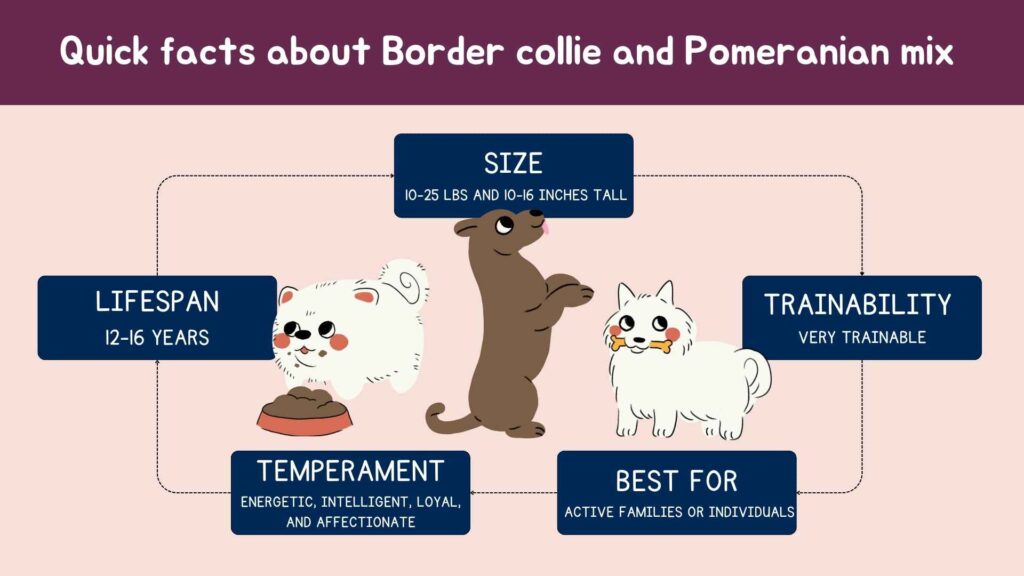
The Border Pom is a hybrid offspring of a purebred Border Collie and a purebred Pomeranian. Usually weighing between 15 and 30 pounds, they are small-to-medium dogs known for their intense loyalty, high intelligence, and thick, fluffy coats.
Table of Contents
ToggleIs the Border Pom a recognized breed?
While the AKC (American Kennel Club) does not recognize the Border Pom as a standardized breed, both parent breeds have prestigious lineages. The Border Collie originated in the Anglo-Scottish borders as the premier sheep-herder, while the Pomeranian descended from large, white Spitz-type sled dogs in the Arctic before being bred down in size in the Pomerania region of Poland and Germany.
The “Hidden Gem” Fact: Many people assume the Border Pom is just a “lap dog,” but they often inherit the MDR1 gene mutation from their Collie lineage. This makes them hypersensitive to certain common medications (like Ivermectin). Always ask your vet for an MDR1 genetic test before administering parasite preventatives.
How Big Do Border Poms Get?
Most Border Poms stand 10 to 16 inches tall and weigh between 15 and 35 pounds. Their size depends heavily on which parent’s genetics dominate, with some appearing like “Miniature Collies” and others like “Jumbo Poms.”
Will my Border Pom fit in an apartment?
You can certainly keep a Border Pom in an apartment, provided you satisfy their mental “work” requirements. Unlike a standard Pom, a Border Pom won’t be happy just sitting on a velvet cushion. They inherit a “seek and find” drive that requires daily engagement. If you leave them alone for 10 hours without a puzzle toy, they will likely “redecorate” your sofa.

Does the Border Collie and Pomeranian mix have a "Working" Temperament?
The Border Pom possesses a high-drive temperament that requires a “job” to prevent destructive behaviors. They are incredibly affectionate but may struggle with “Small Dog Syndrome” if they aren’t given clear boundaries and consistent training from day one.
Are Border Poms good with children?
I find that Border Poms are generally excellent with children, but they possess a “nipping” instinct inherited from the Border Collie’s herding background. If your toddler starts running, the Border Pom might try to “heel” them by nipping at their ankles. Early socialization is non-negotiable to redirect this instinct into fetch or hide-and-seek.
The Owner’s Perspective: Living with a Border Pom means you are never truly alone. They don’t just follow you; they anticipate you. If you pick up your car keys, they are already at the door. If you open the fridge, they are performing a “sit” before you even look down. They communicate with a mix of the Pom’s sharp alert bark and the Collie’s intense, soulful “eye.”
How Much Training Does This Mix Require?
You should plan for at least 30–60 minutes of focused mental stimulation daily. Because they are “too smart for their own good,” a bored Border Pom will quickly learn how to open cabinets or dig through the trash to entertain themselves.
Is the Border Pom hard to housebreak?
Pomeranians are notoriously difficult to potty train due to their small bladders and stubborn streaks. However, the Border Collie’s eagerness to please often “boosts” the trainability of this mix. Use positive reinforcement—think high-value treats like freeze-dried liver—rather than harsh corrections, as both parent breeds are emotionally sensitive and may shut down if yelled at.
The "Hidden" Psychology: Why Do They Bark So Much?
One of the most frequent questions on Reddit’s r/DogTraining involves the vocal nature of this mix. The Pomeranian is a world-class alarm dog; they hear a leaf fall three blocks away and feel the need to report it. The Border Collie is also highly reactive to visual stimuli.
Can you train a Border Pom to be quiet?
Yes, but you aren’t training them to “stop” barking; you are training them to “alert and cease.” By acknowledging the bark (“Thank you, I see it!”) and then redirecting them to a “place” command, you satisfy their instinct to guard while maintaining your sanity. If you ignore the barking, it will escalate into a frantic loop.
Health and Genetics: What Should You Screen For?
Border Poms are generally healthy but are prone to Patellar Luxation (kneecap slipping) and Hip Dysplasia. Responsible owners should ensure parents have OFA (Orthopedic Foundation for Animals) clearances and CERF eye certifications.
Consult with a veterinarian for a personalized health plan.
What are the most common health risks?
- Patellar Luxation: Common in Poms; the kneecap pops out of place, leading to a “skipping” gait.
- Collie Eye Anomaly (CEA): An inherited condition that can lead to blindness or retinal detachment.
- Epilepsy: Both breeds have a documented predisposition to idiopathic seizures, which usually manifest between ages 2 and 5.
- Tracheal Collapse: Inherited from the Pomeranian side, especially if you use a neck collar instead of a harness.
The “Hidden Gem” Fact: Watch out for “Reverse Sneezing.” It sounds like a terrifying honking or choking noise, but it’s actually a common, harmless respiratory event in Pomeranian mixes caused by an irritated soft palate. Stay calm, rub their throat, and it usually passes in seconds.
Grooming and Shedding: Managing the "Triple-Fluff"
Expect a heavy-shedding dog that requires brushing 3–4 times a week. They possess a double coat—a soft, dense undercoat and a longer outer coat—that “blows” twice a year during seasonal changes.
How do I manage the shedding?
You cannot stop the shedding, but you can contain it. You’ll want to invest in a professional-grade grooming kit. Do not shave a Border Pom; their double coat acts as insulation against both heat and cold. Shaving can ruin the coat’s texture and lead to “clipping alopecia.”
Essential Grooming Checklist:
- Slicker Brush: For removing loose undercoat and preventing painful mats.
- Undercoat Rake: Essential during Spring and Fall shedding seasons.
- Metal Comb: To check for “hidden” tangles behind the ears and in the “pants” (the long fur on their hindquarters).
- High-Velocity Dryer: If you bathe them at home, you must get them 100% dry to prevent “hot spots.”
- Enzymatic Toothpaste: To combat the Pomeranian’s tendency toward early tooth loss.
Exercise: More Than Just a Walk Around the Block
If you think a 15-minute stroll will tire out a Border Pom, you are in for a surprise. These dogs have the heart of a marathon runner in the body of a middleweight. They don’t just need physical movement; they need structural exercise.
What are the best activities for a Border Collie and Pomeranian mix?
- Urban Herding (Treibball): Pushing large yoga balls into a goal. This satisfies the herding drive without needing sheep.
- Agility: Their small size and high “jump” power make them stars in the agility ring.
- Nose Work: Hiding treats around the house. This drains more energy in 15 minutes than a 30-minute walk.
The Owner’s Perspective: A tired Border Pom is a cuddle bug. An under-exercised Border Pom is a “veliciraptor.” You will know they haven’t had enough activity when they start “zoomies” around the living room, banking off the back of the sofa like a motocross rider.
Feeding Your Hybrid: Nutrition for High-Metabolism Dogs

Because the Border Pom is so active, they require nutrient-dense food. However, they are also prone to obesity if their caloric intake isn’t strictly monitored. A “portly” Border Pom is at a much higher risk for the aforementioned patellar luxation.
Should I feed a small-breed or medium-breed formula?
Ideally, look for a “high-performance” small breed kibble. They need a high protein-to-fat ratio to maintain their lean muscle mass. I recommend splitting their daily food into two or even three smaller meals to keep their blood sugar stable, especially if they are on the smaller end of the weight spectrum.
Socialization: Turning a "Shadow" Into a Socialite
Both Border Collies and Pomeranians can be “one-person dogs.” Without intensive socialization, your Border Pom may become overly protective of you or “aloof” with strangers.
How do I socialize my Border Pom puppy?
The goal isn’t just meeting people; it’s exposure to surfaces, sounds, and scents. * Weeks 8–12: Introduce them to umbrellas, vacuum cleaners, and people wearing hats.
Weeks 12–16: Focus on “neutrality.” Take them to a park and have them sit quietly while other dogs pass. You want them to look to you for cues, rather than reacting to every movement.
The Cost of Ownership: Is a Border Pom Expensive?

While the initial price of a “designer” puppy can range from $800 to $2,500, the true cost lies in the maintenance. Between professional grooming every 6-8 weeks and the potential for orthopedic issues, you should budget accordingly.
Should I get pet insurance?
Absolutely. Because of the risk of epilepsy and hip dysplasia, getting a policy while they are a puppy (before any “pre-existing” conditions appear) is the smartest financial move you can make. One emergency vet visit for a luxating patella can cost upwards of $3,000.
Where to Find a Border Collie and Pomeranian mix: Rescue vs. Breeder
Finding this specific mix can be a challenge. You won’t find them at every local shelter, but they do appear in breed-specific rescues.
Should I look at Border Collie or Pomeranian rescues?
Yes! Often, “Border Collie Excellence” or “Pomeranian Rescue of [Your State]” will take in mixes. If you choose a breeder, ask for the “DNA Parentage” results. In the world of designer dogs, some “Border Poms” are actually just long-haired Chihuahuas or Aussie mixes. A reputable breeder will show you the health clearances of the parents without hesitation.
Living with a Legend: Final Thoughts on Border Collie and Pomeranian mix
The Border Collie and Pomeranian mix is a dog of contradictions. They are tiny but tough, fluffy but functional, and independent yet incredibly needy. They require an owner who views dog ownership as a hobby, not just a chore.
If you provide the structure of a Border Collie and the adoration of a Pomeranian, you will have a companion that is quite literally the “Final Word” in canine loyalty. They aren’t just pets; they are little geniuses waiting for someone to give them a world to explore.
People also ask:
There’s a lot of variety because some Border Pomeranians have fluffy coats. They’re usually lean and energetic. They typically have almond-shaped eyes and a Border Collie mix will have ears that are upright or floppy or a mix of both. The Pomeranian Border Collie cross will depend on the dominant parent’s genes any parent along the line.
Most of the time Border Pom are easy to train. Border Collies are intelligent and are quick learners so motivating and loving training is a must because otherwise their brain will turn stubborn on you.
With the right early socialization, they can be incredible family pets, but gentle play is a must. The Border Pom is a well-loved dog and has a great family friendly, but the herding instinct tends to make a nipping or herding action around toddlers if the play is not suitable.
Most will be the small to the medium 10-25 lbs and 10-16 in at the shoulder. The mix will dictate the Border Pom size.
Since it is a small breed and a herding breed, watch for patellar luxation, eye disorders, hip and elbow dysplasia, dental issues, and infrequently, some neurological and cardiac conditions. Regular vet checkups and responsible breeding reduce these risks.
You may also like







Build the Perfect Care Routine for Your Pomeranian

Select your Pom’s age, coat type, and activity level to instantly get a custom care checklist — it’s fast, free, and made with love!
Give your Pom the daily care they truly deserve.