Most Recommended Dog Beds for Pomeranians
Lateef Bhatti
Author
🕐 13 min read | Updated: Jun 08, 2026
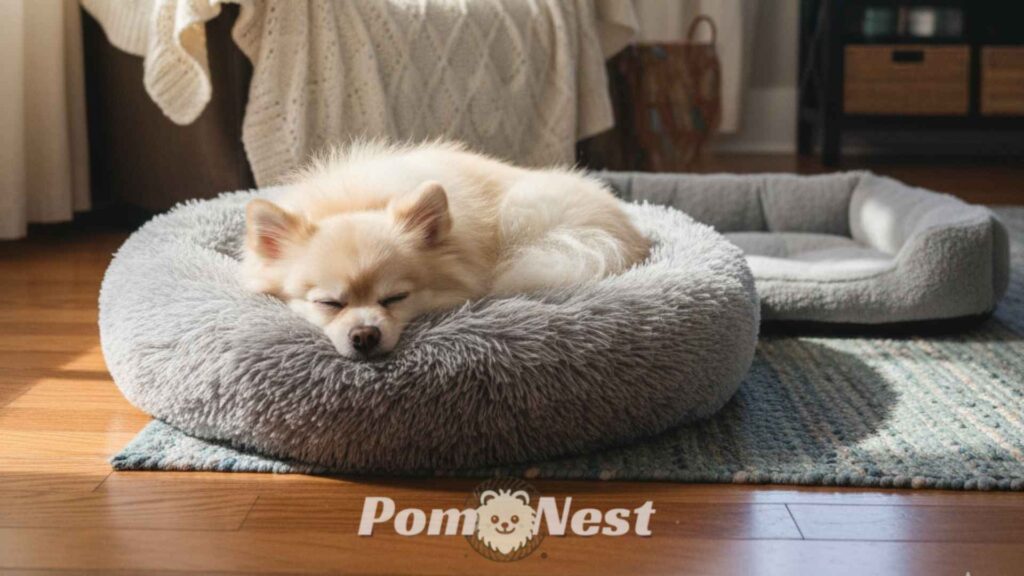
Dog beds for Pomeranians need to support their joints and give them a place to snuggle up. They also need to protect their fur with materials. Good options include memory foam, bumper beds and raised cots.. The best one for your Pom depends on their age, where they live and how they sleep.
Table of Contents
Toggle
A Pomeranian owner named Sarah told me about her problem in January 2026. Her two-year-old Pom, Coco stopped sleeping on her bed. Only wanted to sleep on the living room floor under the radiator. Sarah had already bought a round bed for $120 but Coco didn’t use it.
The bed was pretty. It wasn’t right for Coco. After switching to a bumper bed with raised sides and a washable interior Coco loved it. Slept through the night without restlessness. The difference wasn’t about the price; it was about understanding what Pomeranians need from a bed.
Here’s what you might not know when searching for dog beds online: most pet beds are made for Labrador Retrievers. The average dog bed is for a 40-pound dog that sleeps flat and doesn’t have a coat. Pomeranians weigh 3-7 pounds sleep curled up. Shed a lot.
Finding the bed for your Pomeranian is crucial for their well-being. Just because they’re small doesn’t mean any small bed will do. They need things like joint support and coat protection, which most generic dog beds don’t offer.
This guide covers what I’ve learned about dog beds for Pomeranians over two years. You’ll learn why the type of bed matters more than the price the risks of letting your Pom sleep in your bed how to choose a bed based on their life stage and which products work well. I’ll also discuss the importance of hygiene, which is closely tied to comfort for coated dogs, like Pomeranians.
Why Do Dog Beds for Pomeranians Need to Be Different?
Dog beds for Pomeranians need to address three specific requirements that generic beds ignore: joint vulnerability from patellar luxation, coat protection from static and friction, and nesting instinct satisfaction through enclosed or semi-enclosed design.
What matters most is whether your Pomeranian is able to relax, sleep soundly, have their aching joints supported, and keep their remaining fur protected in the process. In the lines to come, we will discuss the reasons why a Pomeranian should have their own bed, the dangers of a shared mattress, and how to select the right bed for your furry friend.
The joint issue is the most clinically significant. Pomeranians are genetically predisposed to Grade 1 and Grade 2 patellar luxation, which means their kneecaps dislocate partially during movement. A bed that does not provide even, firm support across the entire sleeping surface creates pressure points that aggravate this condition nightly. Over months and years, the cumulative damage from sleeping on an unsupportive surface contributes to earlier onset of osteoarthritis than the breed would otherwise experience.
The coat issue is equally important but less medically obvious. Pomeranians have a two-layer coat: a dense, cotton-like undercoat and longer, coarser guard hairs on top. Beds made with rough fabrics or synthetic materials that generate static electricity cause the guard hairs to tangle, break, and develop friction mats. Anti-friction dog beds for Pomeranians are specifically designed not to snag the luxurious double coat. This distinction separates a genuinely Pomeranian-appropriate bed from a bed that simply comes in a small size.
The Nesting Psychology of the Pomeranian
Here is something that took me a while to fully understand about this breed. Pomeranians are descended from Nordic working spitz dogs. Their ancestors slept in snow burrows, curled tightly with their tails over their noses for warmth. That instinct is still fully operational in your 5-pound companion dog.
When a Pom circles a sleeping surface repeatedly before lying down, they are not just being adorable. They are performing a behavioral sequence inherited from ancestors who needed to compress snow and grass into a thermal nest. A bed that does not allow this circling and compressing behavior, specifically a flat mat with no walls or raised edges, will never fully satisfy this instinct. This is why bumper beds and donut-style beds consistently outperform flat mats for Pomeranian adoption rates.
Why Your Pomeranian May Need Their Own Bed
Your Pomeranian might enjoy the comfort of your presence, but there are important reasons why they should have their own bed. A proper sleep position allows them to find a genuine sense of comfort and full muscular relaxation. A secure bedding space for a toy breed allows complete relaxation without the need for your presence. Dogs that have to share beds with humans often develop higher levels of separation anxiety because they are not accustomed to relaxing without their owners nearby.
Another significant reason is physical safety. Small dogs such as Pomeranians are able to fall over or get rolled over in a shared bed, which could lead to serious injuries. Having a bed sized appropriately protects your dog and helps maintain your own sleeping space free from fur, dander, and the occasional accident. After some time, such changes in routine prove beneficial to your dog’s confidence and long-term wellness.
The independence factor is something I initially underestimated. A Pom that sleeps exclusively with their owner can develop what experienced breeders call velcro-dog syndrome, which is an extreme dependency on human proximity that manifests as anxiety, excessive barking, and destructive behavior when left alone. Teaching your Pom to sleep independently in a bed they love builds the confidence and self-regulation capacity that makes them easier to manage across their entire 12 to 16-year lifespan.
What Are the Potential Problems With Allowing a Pom to Sleep in Your Bed?
Having your Pomeranian lie next to you in bed might seem like an innocent act, but there are numerous underlying issues that arise as a result of this practice. Pomeranians are not only very small in size and dimensions, but they are also fragile and accident-prone, which makes bed sharing genuinely detrimental to the well-being of the dog.
The risks of bed sharing with a Pomeranian fall into five clear categories.
Fall Risk: The dog might fall from the bed, and even a minor fall could be detrimental for their knees and hips. A Pomeranian falling from a standard 24-inch bed height experiences a fall equivalent to a human falling from roughly 15 feet in terms of body-height ratio. Given their patellar vulnerability, this is not a theoretical risk. It is a common cause of emergency vet visits for toy breeds.
Rolling Injury: The person sleeping might unknowingly roll over the dog during deep sleep. A 5-pound dog can be seriously injured by even partial compression during a sleep cycle. This risk increases significantly with larger sleeping partners.
Separation Anxiety: Dogs with the habit of sleeping with people experience the highest levels of anxiety and stress when they are left home alone. The co-sleeping pattern creates a dependency that makes every solo absence feel like abandonment.
Hygiene and Cleanliness: Pomeranians are heavy shedders. Fur, dander, and occasional accidents can make a mattress genuinely difficult to keep clean. Over months, this creates an allergen-dense sleeping environment for both you and your dog.
Joint Health Concerns: Small toy breeds prone to knee and hip issues need a properly sized, supportive, structured sleeping surface. A human mattress does not provide the firm, even support that a Pomeranian-specific orthopedic bed delivers.
Teaching your Pom to rest on their own bed is not about denying them your love. It is about protecting their health, fostering healthy autonomy, managing your own sleep quality, and maintaining genuine hygiene in your bedroom.
Hygiene for Pomeranians – Dog Beds for Pomeranians Hints
When it comes to your Pom, the aesthetic appeal of the bed is not the only consideration. Its support, hygiene, and comfort tailored to their individual needs matter greatly. An excellent place to start is a supportive canine mattress or a sized-for-Pomeranian memory foam dog bed that will safely cradle and support the comfort, hips, and joints of their little frame. Appropriate support ensures that no pressure points are formed on active and older Pomeranians, minimizing stiffness and soreness over time.
The quality of the material is crucial. The cover on a washable dog bed is practically essential for a fur-producing, double-coated breed. Anti-friction dog beds for Pomeranians are great for not snagging the luxurious coat. The bed’s anti-static fabric is designed specifically not to tangle or cause friction during sleep movement. Bumper beds give Pomeranians a sense of security, which is important for feeling truly cozy and settled. Small dog raised cots are ventilated for dogs that tend to overheat despite their insulating double coat.
Here is the hygiene detail that most dog bed guides completely skip. Pomeranian undercoat is particularly effective at trapping moisture against foam surfaces. In a bed without a removable, machine-washable cover, that moisture creates a slow-growing bacterial and mold environment inside the foam core within three to six months of regular use. The bed looks fine on the outside. Inside, it is a genuine health risk for a dog sleeping on it eight to twelve hours per day.
My rule for any dog bed for Pomeranians is straightforward: if the cover cannot be removed and machine-washed on cold at least once per week, the bed does not belong in a Pom household. This eliminates a significant percentage of the products marketed as small dog beds.
Best Dog Beds for Pomeranians
Let me walk through every major bed category with the specificity this breed deserves. Each type has a genuine use case and genuine limitations that most reviews flatten into generic talking points.
Orthopedic Memory Foam Bed
The orthopedic memory foam bed is the gold standard for senior Pomeranians and for any dog recovering from patellar luxation surgery or diagnosed with early-stage arthritis. The foam conforms to the dog’s body, distributing weight evenly across the sleeping surface and eliminating the pressure points that a flat, compressed-foam bed creates after a few months of use.
Pros: Perfect for Pomeranians who are aged or in recovery, as memory foam provides outstanding support for joints and the spine. Provides spinal alignment and reduction of pressure points across the hips and shoulders. The dog bed cover is typically machine washable, which is a critical hygiene feature. Top-grade dense memory foam maintains its shape and structure for 18 to 24 months of regular use before requiring replacement.
Cons: Considerably more expensive than other alternatives, with quality options ranging from $60 to $120 as of June 2026. Not practical for travel since memory foam is heavy and less portable. Some Poms with strong nesting instincts prefer the enclosed feeling of a bumper or donut bed over the flat surface of a memory foam mat, and no amount of product quality will override that behavioral preference.
My honest assessment: for dogs over 7 years old or dogs with diagnosed joint conditions, the orthopedic memory foam bed is the right call regardless of cost. For healthy adults under 5, a bumper or donut bed is usually the better behavioral fit.
Quality Bumper Dog Bed
The bumper bed is my most-recommended starting point for first-time Pomeranian owners and for healthy adult Poms without specific medical requirements. The raised sides satisfy the nesting instinct directly. The dog can press their back against the wall of the bumper, which mimics the security of a den and triggers the same calm response as burrow sleeping.
Pros: The raised sides offer your Pom a secure feeling that nesting toy breeds genuinely need for full relaxation. Lightweight and easily transportable, which makes it practical for moving between rooms or taking to a dog-friendly hotel. Available in a wide range of colors and fabric options to match home decor, which I acknowledge is less medically important but matters to real buyers.
Cons: Does not provide sufficient orthopedic support for joint issues due to the lack of memory foam in the base. The bulky bumper edges catch fur and debris and require more frequent cleaning than flat-surface alternatives. Not ideal as a sole solution for senior dogs with confirmed patellar or hip issues.
Pricing for quality bumper beds sits between $30 and $65 as of June 2026. The midrange options from brands like Best Friends by Sheri and Furhaven consistently perform well for the Pomeranian size range.
Raised Dog Cot for Small Breeds
The raised cot is the most underappreciated option in this category for warm-climate Pom owners. Air circulation under the bed prevents the heat accumulation that a dense, foam-base bed creates, which matters significantly for a double-coated breed during summer months.
Pros: Excellent for Pom beds in hot climates since air circulates freely under the sleeping surface, preventing the hot-house effect common in plush designs. Great for outdoor or patio use due to sturdy, chew-resistant construction that handles weather exposure. Easy to wipe down and clean, which reduces the hygiene maintenance burden for busy owners.
Cons: The uncovered mesh or fabric surface may feel too firm for Poms with sensitive joints, requiring an added mat or attachable orthopedic pad. Some Poms are initially reluctant to climb up onto the elevated surface, particularly seniors or dogs with existing joint stiffness.
Specialty Enclosed or Tent Style Bed
For anxious Pomeranians, dogs with noise sensitivity, or dogs in households with multiple pets competing for space, the enclosed tent bed is the single most effective anxiety-reduction tool available that does not require veterinary intervention.
Pros: For shy or anxious dogs, it creates a cozy, den-like atmosphere that mirrors the psychological security of burrowing. Provides genuine privacy by blocking light and muffling sound, which significantly reduces environmental stress triggers. Functions as a playful decor addition to the home while serving a real behavioral purpose.
Cons: Can get too warm without sufficient internal circulation, particularly for dogs with dense coats in summer months. If the cover cannot be removed, staining makes it very difficult to keep clean, which is a serious limitation for a dog breed known for heavy shedding.
Travel or Portable Beds
Travel beds for Pomeranians solve a specific problem: maintaining your dog’s sleep routine during transitions. A Pom that sleeps well at home on a familiar surface will sleep poorly in a hotel, a grooming facility, or a relative’s house without something familiar.
Pros: Compact size makes transport simple during trips, hotel stays, or car rides. Fits easily into a carry bag, which makes it practical even for air travel in a cabin bag. Accessible price point, typically $20 to $45 as of June 2026, which makes it a low-risk purchase.
Cons: Provide significantly less structural support than permanent beds, which means they should supplement rather than replace a primary sleeping setup. They can wear down relatively quickly if folded and unfolded frequently, so quality of zipper and fabric matters more in this category than in static beds.
Heated or Self-Warming Beds
For winter months, post-grooming recovery periods, and Pomeranians with Alopecia X who have lost significant coat insulation, a heated or self-warming bed addresses a genuine thermal need. If you want more detail on heating pads specifically, the Best Puppies Heating Pads for Pomeranian Dogs guide covers the full product range and safety protocols.
Pros: Excellent for smaller Poms as they get cold easily and benefit from consistent ambient warmth during winter months. Some self-warming beds use reflective technology that requires no electricity, using the dog’s own body heat to create a warm microclimate, which eliminates electrical safety concerns entirely.
Cons: Electric self-warming beds require ongoing vigilance for cord safety, particularly with younger Poms who are still in their chewing phase. In warm weather, a heated bed can push core temperature above the comfortable range for a fully-coated adult Pom, so seasonal storage or replacement is necessary.
Cooling Gel or Breathable Beds
The cooling gel bed is the summer counterpart to the heated bed, and it is more relevant for Pomeranian owners in warm climates than most guides acknowledge. Poms in regions with summer temperatures consistently above 80°F benefit from a sleeping surface that actively dissipates body heat.
Pros: Perfect for warm areas and for dogs that heat up quickly due to their dense double coat. Provides a comfortable surface that keeps the dog from overheating during long sleep periods.
Cons: More expensive than standard dog beds, with quality options starting at $55 as of June 2026. Not recommended for winter use unless paired with a cover or blanket that adds insulation.
Steps and Ramps for Easy Dog Bed Access: A Critical Addition
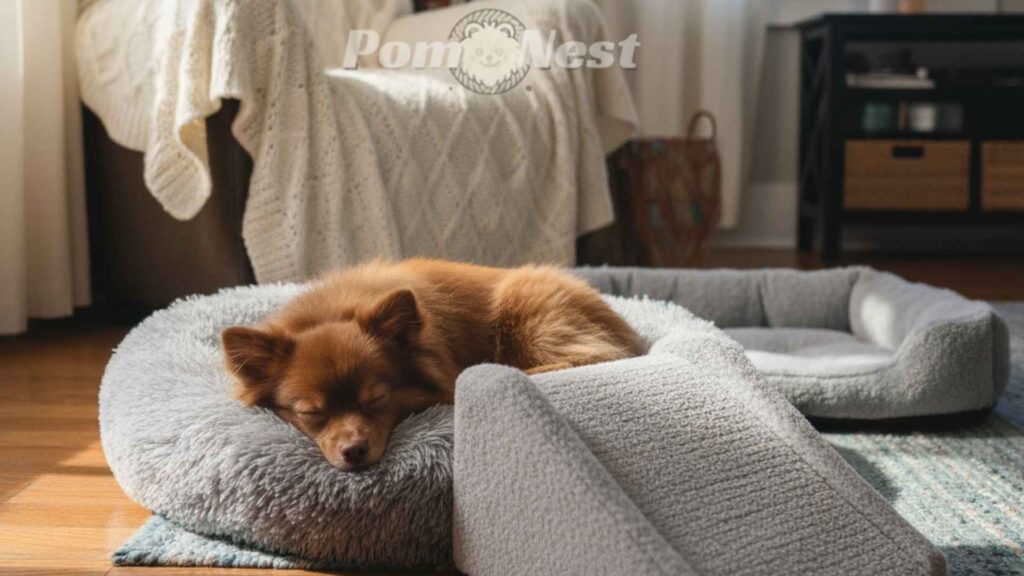
Even if your Pomeranian spends part of the night in your bed, they will still need to be able to get there and back down easily. Jumping from a considerable height has the potential to injure a Pomeranian’s delicate joints or, in the worst case, cause a serious accident that requires surgical intervention.
The patellar joint is the primary concern here. A Pomeranian landing from a 24-inch jump height generates impact force that is disproportionate to their body weight. Over thousands of jumps across a lifetime, this cumulative impact accelerates the progression of Grade 1 luxation toward Grade 2 and potentially Grade 3, at which point surgical correction becomes necessary.
Steps and ramps allow your Pom to climb and descend with a dramatically lower chance of sustained injury from a fall. Ramps are great for older Pomeranians or any Poms who suffer from knee or hip issues, while steps are great for younger, more energetic Pomeranians who require a little more elevation challenge. Look for designs that are easy to stabilize and that have non-slip surfaces on every step or ramp section. Ramps or steps that attach directly to beds and couches are the safest long-term investment for maintaining your Pom’s joint health across their entire lifespan.
How to Choose the Right Size Dog Bed for a Pomeranian
The sizing question is one I get consistently from new Pom owners, and the answer is more nuanced than most size charts suggest.
Measure your Pomeranian from the tip of their nose to the base of their tail while they are lying in their natural sleeping position, which for most Poms is a tight curl. Add 4 to 6 inches to that measurement. That is the minimum interior diameter you need for a round or donut bed. For a rectangular bed, add 6 to 8 inches to both length and width.
Here is where I push back on the conventional wisdom. Most guides tell you to buy big. I disagree for Pomeranians specifically. A bed that is significantly oversized defeats the nesting instinct. The dog needs to feel the walls of the bed when they curl up, not simply lie in the middle of a space that feels like an open field. A snug fit is a calmer fit for this breed. The psychological security that comes from feeling enclosed on multiple sides directly reduces the ambient anxiety that many Poms carry through the day.
For standard adult Pomeranians, a round or donut bed with an interior diameter of 18 to 22 inches works well. Puppies are comfortable in a 14 to 16-inch interior. Senior Poms may need slightly more room if they struggle to curl tightly due to joint stiffness.
What Fabric Is Best for Dog Beds for Pomeranians?
The fabric question matters enormously for this breed, and it is the area where most mainstream dog bed guides provide the least useful information.
The double coat of a Pomeranian interacts with bed fabric in three specific ways: static electricity generation, friction damage to guard hairs, and moisture trapping in the undercoat. Each of these has a best-practice fabric solution.
For static electricity: Avoid synthetic fleece and polyester plush in their pure forms. These materials generate static that causes the guard hairs to stand, tangle, and eventually break at the root. Look for beds labeled anti-static or those using natural fiber blends in the interior surface.
For friction damage: The interior sleeping surface should have a smooth, low-pile texture. High-pile shag or faux sheepskin looks luxurious but creates the kind of friction that gradually damages the guard hair tips, leading to a dull, frayed coat appearance that no amount of grooming fully resolves.
For moisture management: The cover must be removable and machine washable. Beyond that, look for covers that use moisture-wicking fabrics in the base layer, which draw undercoat moisture away from the foam rather than allowing it to saturate. This prevents the bacterial and mold growth in the foam core that I mentioned earlier.
Seasonal Bed Strategy for Pomeranians: What Changes and When
Most Pomeranian owners use the same bed year-round without adjustment, and I think this is a missed opportunity for meaningfully improving your dog’s comfort and health.
Winter (October through March in most climates): The primary need is warmth retention. A bumper or donut bed with plush interior combined with a self-warming insert covers most Poms adequately. For dogs in genuinely cold environments (below 60°F indoors), adding a removable heated pad under half the sleeping surface provides consistent thermal support. See the Best Puppies Heating Pads for Pomeranian Dogs guide for specific product recommendations.
Spring and Fall (transition seasons): The shedding seasons. During spring and fall coat blows, your Pom will deposit significantly more undercoat into their bed. During these periods, increase washing frequency to twice weekly and check the foam base for any compression or moisture accumulation. This is also when anti-friction fabric becomes most critical, as the guard hairs are at their most vulnerable during active undercoat cycling.
Summer (June through August in most climates): Switch to a raised cot or cooling gel bed. Remove any insulating covers. If your home air conditioning keeps temperatures consistently below 72°F, your standard bed may be fine year-round. But for dogs in warmer homes or climates, the thermal relief of a breathable sleeping surface has measurable impact on sleep quality and daytime energy levels.
Common Mistakes Pomeranian Owners Make When Buying Dog Beds
I have seen these five mistakes repeatedly, and each one is entirely preventable with the right information.
Mistake One: Buying for looks. The most popular dog beds on Instagram are round, fluffy, pastel-colored, and made with high-pile faux fur. They are also frequently made from static-generating synthetic materials with non-removable covers. They look perfect in a photo and are a practical nightmare for Pomeranian coat management.
Mistake Two: Buying too large. As I noted in the sizing section, oversized beds do not satisfy the nesting instinct. A Pom floating in the center of a 30-inch bed is not comfortable. They are searching for walls that are not there.
Mistake Three: Ignoring the foam quality. The cover gets the attention, but the foam is where the investment actually matters. Low-density foam compresses to almost nothing within 60 to 90 days of regular use. Pressing your hand firmly into the base of any bed before buying, or reading verified reviews specifically about long-term foam performance, is non-negotiable.
Mistake Four: Never washing the cover. I have spoken with Pomeranian owners who have never washed their dog’s bed cover in three years of use. The hygiene implications are significant. Weekly washing is the standard for a double-coated dog. Monthly is the absolute minimum.
Mistake Five: Skipping the ramp or steps. This is the most consequential mistake in terms of long-term joint health. The average Pomeranian makes 20 to 30 bed entries and exits per day across all furniture. Over a 14-year lifespan, that is over 100,000 joint-impact events. Stairs or a ramp reduces the impact force of each of those events by approximately 70 percent. The investment cost of a quality ramp, typically $30 to $60, is trivial compared to the surgical cost of Grade 3 patellar luxation repair.
The Final Verdict on Dog Beds for Pomeranians
Selecting the right sleeping setup for your Pom is one of the highest-leverage care decisions available to you as an owner. It costs relatively little compared to veterinary intervention, it has measurable impact on joint health and sleep quality, and it compounds positively over the 12 to 16-year lifespan of a healthy Pomeranian.
The framework I recommend, built on two years of working with this breed, is straightforward. Start with a bumper or donut bed in the correct size for your dog’s age. Ensure the cover is removable and machine washable. Choose anti-friction, anti-static interior fabric. Add a ramp or steps to all furniture your dog accesses regularly. Switch to a memory foam base for dogs over 7 years or dogs with diagnosed joint conditions. Add seasonal thermal management through a heating pad in winter or a raised cot in summer.
None of these decisions require significant financial investment. What they require is understanding that dog beds for Pomeranians are not a generic product category. They are a breed-specific solution to a set of breed-specific biological and behavioral needs.
My prediction for this category through 2027: expect to see more hybrid beds combining orthopedic memory foam bases with bumper-style surrounds becoming the standard recommendation for veterinarians working with toy breeds. The technology already exists. The market awareness is catching up. If you invest in one of those hybrid designs now, you will not need to upgrade when that recommendation becomes mainstream.
FAQs
Pomeranians like beds with bumpers or pocket beds where they can curl up and feel secure. Memory foam or cushioned mattresses provide enough support for Pomeranians.
The bed can be classified as extra small or small. The sleeping area should be the length of the dog plus a minimum of 6-12 inches. The space should allow the Pomeranian to stretch or curl.
Pomeranians sleep where they feel secure, usually in a den-style bed or close to the owner. Many Pomeranians prefer sleeping at the foot of the bed or near the couch.
For puppies it is best to use a bed that has a low entry and is soft. The bed should also be easy to clean and made of durable material. The covers can be bolstered, or the sides may be cushioned.
Pomeranians cherish attention and the feeling of companionship. Along with the routine, they feel secure. Pomeranians like warmth, praise, and fun activities.
You may also like
Build the Perfect Care Routine for Your Pomeranian

Select your Pom’s age, coat type, and activity level to instantly get a custom care checklist — it’s fast, free, and made with love!
Give your Pom the daily care they truly deserve.